Guide
How fictitious pickup actually works
The sequence an impostor follows to collect freight they were never booked to carry, and the exact point where checking documents stops being useful.
 Swap: article image
The sequence an impostor follows to collect freight they were never booked to carry, and the exact point where checking documents stops being useful.
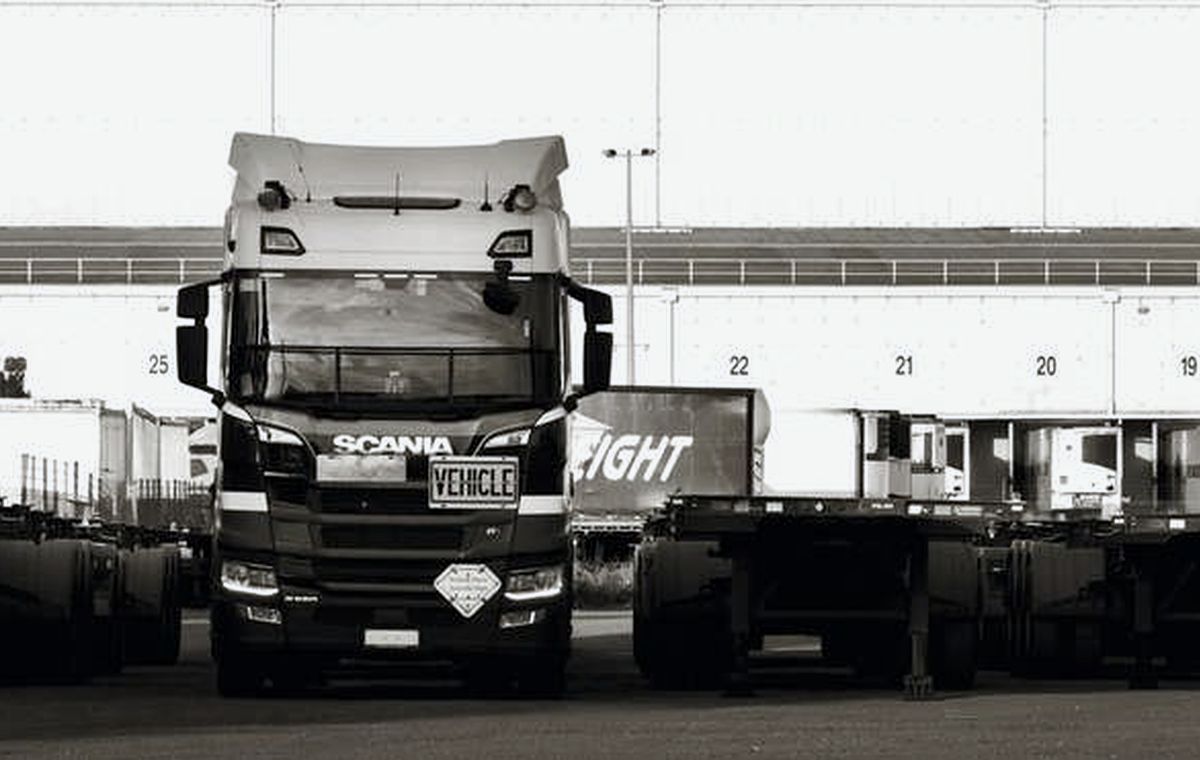
Swap: article imageFictitious pickup is not a sophisticated attack. It works because every control in a normal pickup checks something that can be copied, and nothing checks the one thing that cannot be: the physical vehicle that reverses onto the dock.
The specifics vary, but the shape is consistent. Each step is ordinary on its own, which is exactly why the whole thing passes.
Each step is ordinary on its own. Vetting runs at stage 02 and passes, because the papers belong to a real carrier. The vehicle is never looked at.
Pickup controls check three things: a carrier record at booking, a person at the gate, and a piece of paper in that person's hand. All three can be reproduced by anyone holding the pickup number, and the first one — the carrier record — was verified days before the truck turned up.
The gap is not that the checks are weak. They are reasonable checks of the wrong object. A carrier record describes an organisation. A driver licence describes a person. A bill of lading describes a load. None of them describe the tractor and trailer standing at the dock, and the tractor and trailer are what leaves with the freight.
Three controls, three different objects. The one that leaves with your freight is not among them.
The impostor does not have to defeat your vetting. They have to arrive after it, which they do by default, because vetting happens at booking and collection happens at the dock.
To close the gap, a check at the dock has to answer three questions that documents cannot, and it has to answer them before the freight is loaded:
Every tractor and trailer on a US road carries a federal certification label. Under 49 CFR 567.4, that label must be affixed so that, unless riveted, "it cannot be removed without destroying or defacing it", it must carry the vehicle identification number, and on a trailer it goes "to a location on the forward half of the left side" where it is "easily readable from outside the vehicle without moving any part of the vehicle".
That makes it the one marking on a commercial vehicle that is both unique to that vehicle and deliberately hard to move. It is the natural place to anchor an identity check, which is why Stower binds a tag across its edge rather than to a door, a bumper or a windscreen.
49 CFR 567.4 requires the label to carry the VIN and to resist removal. A tag bound across its edge inherits both properties.
Verifying the vehicle at the dock does not stop a legitimately booked carrier from stealing a load, and it does not help once the freight has left a site that has no fixed tag. It closes one specific door: the impostor who arrives in a vehicle that was never the one booked. That door is the one most fictitious pickups walk through.
This guide describes a pattern of freight theft in general terms. It is not legal advice and it is not a complete account of every method in use.
Carrier selection under paragraph (e), in-transit loss reporting under paragraph (c), and what a DEA registrant can realistically evidence about a pickup.
Read it →Fifty facilities, thirty-two carriers, and an average of thirty seconds added to a collection. What a year of verifying the vehicle instead of the paperwork looks like.
Read it →Fifteen minutes is enough to walk you through a real one. Tell us a little about your operation and we'll set it up.